Showing posts with label Ty Hyll. Show all posts

Wednesday, 28 May 2014

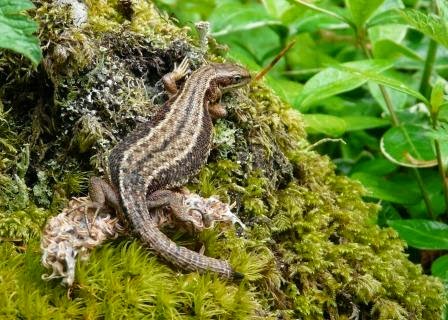
Beautiful Lizard at Ugly House

I dropped in to the Ugly House today to see what was new; thank goodness the food and the welcome were as good as ever. The gardens were looking brilliant and I could not resist buying £25 worth of bargains from the plant stand, all in perfect condition and meticulously labelled with pencil on wood.

On the path up to the compost toilet was a basking lizard, incredibly fat with a stubby tail; were baby lizards imminent? Or had it just eaten someone's sandwich?

Further into the woods were a series of beehive boxes marked THN1 and THN2 - Tŷ Hyll Nucleus hives? Apparently they have been left there on the off chance of attracting a swarm. The full scale hives at the top of the woods had increased from 2 to 3. In many places were sheets of corrugated metal and other materials, presumably to attract things like snakes?

In front of the tea rooms was Lisa, with an illustrated hive, taking out the frames to explain cross sections of what goes on inside. More unbelievable than science fiction but clear to understand.

If you would like to learn more about what goes on at Tŷ Hyll there is a bee friendly day on Saturday 31st May with candle making, seed sowing, tree decorating, bee hunt & quiz, bee-friendly gardening advice throughout the day and visits to bee hives and talks on beekeeping. Full details here.

On 30th June there is another event: A Pollinator Friendly Garden Day -
Trees and Shrubs for Bees. Details of this event are here.  

Thursday, 22 August 2013

The Ugly House Insect Hotel

Tŷ Hyll (the Ugly House) is a showcase for honeybees doing pioneering conservation work to create a plentiful supply of local queens; but what about the other 2,000 different species of insect that might be living in the grounds? Many insects are declining in numbers, such as bumblebees and solitary bees, and could do with a helping hand. To that end we have built an insect hotel designed and supervised by Rosie Barratt from the North Wales Wildlife Trust and assisted by two students from Bangor.

Our hotel is a luxurious, five-storey affair set into the hillside with a south facing aspect overlooking the Ugly House and the Afon Llugwy.  No expense was spared in obtaining the materials with five discarded pallets, begged from a local builders merchant, creating the main structure. You can tell it’s a Welsh hotel as it has a slate roof with what looks like a bit of pond liner beneath to keep the bug beds (not bed bugs) nice and dry.

If you want to build your own I can strongly recommend enlisting Rosie’s assistance. But in case she is not available here below are some instructions borrowed from a Wildlife Trust website.

Where to site your insect hotel?

Many invertebrates like cool damp conditions, so you can site your habitat in semi shade, by a hedge or under a tree. Putting the habitat close to other wildlife features, such as an overgrown hedge, a shrubbery or a pond will make it easier for small creatures to find it. Not all creatures like to be in the shade: solitary bees like a warm sunny spot, so put tubes for bees on the sunniest side of the habitat, or put them elsewhere in the garden. Choose a level, even surface: the hotel may end up fairly heavy, so will need a firm base. 
Drilling bug beds -
cunningly camouflaged so as not to alarm the bees

The basic structure

Old pallets, preferably the same size,  are ideal for the basic structure; the more you can use recycled or reclaimed materials the better. The hotel does not need to be more than 5 pallets high. If you place the bottom pallet upside down, this should create larger openings at the ends, which can be used for a hedgehog house. Although the structure should be stable, you might want to secure each pallet to the one below.

Filling the gaps or furnishing the bedrooms

There are many different ways to fill the gaps in the structure, here are some suggestions:

Dead wood - this is an increasingly rare habitat as we tidy our gardens, parks and amenity
woodlands. It is essential for the larvae of wood-boring beetles, such as the stag beetle. It also supports many fungi, which help break down the woody material. Crevices under the bark hold centipedes and woodlice.

Holes for solitary bees - there are many different species of solitary bee and all are excellent pollinators. The female bee lays an egg on top of a mass of pollen at the end of a hollow tube, she then seals the entrance with a plug of mud. A long tube can hold several such cells. Hollow stems, such as old bamboo canes, or holes drilled into blocks of wood, make good nest sites for solitary bees. Holes of different diameters mean many different species can be catered for. You can make a home for solitary bees by collecting old canes or pieces of hollow plant stems, then placing in a length of plastic drain-pipe or a section from a plastic drinks bottle. You can also build a wooden shelter, similar to a bird box. Solitary bees like warmth, so place your habitat in a sunny spot. Bees use differing ways to seal their egg chambers: look out for canes blocked with dried mud or bits of leaf. 

Frog hole - stones and tiles provide the cool damp conditions that frogs and other amphibians need. Amphibians also need a frost free place to spend the winter; this could be in the centre of the hotel.

Straw and hay provide many opportunities for invertebrates to burrow in and find safe hibernation sites.

Dry leaves provide homes for a variety of invertebrates; this mimics the litter on the forest floor.

Loose bark - beetles, centipedes, spiders and woodlice all lurk beneath the decaying wood and bark. Woodlice and millipedes help to break down woody plant material and are essential parts of the garden recycling system.

Crevices - many garden invertebrates need a safe place to hibernate in through the winter. Our insect hotel has many different types of crannies and crevices that different species of invertebrate can hide in over winter.

Lacewing homes - lacewings and their larvae consume large numbers of aphids, as well as other garden pests. You can make a home for lacewings by rolling up a piece of corrugated cardboard and putting it in a waterproof cylinder, such as an old lemonade bottle.

Ladybirds and their larvae are champion aphid munchers! The adults hibernate over winter and they need dry sticks or leaves to hide in.

Bumblebees - every spring queen bumblebees search for a site to build a nest and found a new colony. An upturned flowerpot in a warm sheltered place might be used.

Nectar producing plants - why not plant some nectar-rich flowers in the hotel’s garden. These provide essential food for butterflies, bees and many other flying insects.

Friday, 17 May 2013

Have you got the energy to do something about it?


Charcoal maker at work
Rural Wales is being hit hard by rising energy costs.  A recent survey on the Llŷn found that 75% of households are in or at risk of fuel poverty, with the average household’s heating bill 65% higher than the UK average.  There are ways to heat and power homes which are not vulnerable to oil and gas prices and many businesses and families in Snowdonia are starting to use them.  

How much does it cost? Can it pay for itself? What effects has it had? Profiad Ni’s Open Doors Trail features 20 buildings across Snowdonia where visitors can see features like solar panels, heat pumps, biomass boilers, solar hot water systems and more. 

The Open Doors Trail will take place from the 24th to the 26th of May and is preceded by a week of shorter events (18th - 24th of May) including an Energy Bills Drop-in Clinic in Bangor, a tour of Derwydd farm in Llanfihangel Glyn Myfyr which generates renewable electricity and a workshop on how to start community or privately owned hydro electricity projects at Plas Tan y Bwlch.  The full events timetable is available at www.ProfiadNi.org.

For my part I will be running a Natur Cymru / Snowdonia Society stall at the Green Shoots Sustainability Fair in Penrhyndeudraeth, Neuadd Goffa, from 10am till 4pm on Saturday 18th May and showing people around at Tŷ Hyll on Friday 24th May. 

Monday, 29 April 2013

Rearing Queen Bees

We are rearing queen bees in the woods of Tŷ Hyll (the Ugly House) to sustain local bee-keeping in the Conwy valley.  To explain the process we need to set the scene as to what goes on in the hive and who does what. If you know all this already just skip to the final section.

There is one queen bee in each hive or colony of honey bees and all she does is lay eggs, maybe 2,000 a day for her 2 to 3 years of productive life. Fertilised eggs will become workers (females) or queens; unfertilised will be drones. Within a typical hive in summer there are about 2,000 drones, whose sole purpose is to mate with a virgin queen, and up to 60,000 workers, who do everything else in organised social harmony.

Image courtesy of NASA
The life of the worker bee
When a worker emerges into the darkness of the hive she will instinctively clean out her cell ready for another egg to be laid or for food to be stored. Learning by touch from older workers, she will help clean the hive, preparing cells for new eggs (brood) or for nectar and pollen (stores).

At 3 days she is a brood nurse, using stores to feed newly hatched larvae, and taking her turn to feed queen larvae with royal jelly, which she is now old enough to secrete. She will also attend the queen, guiding her to stores to feed and to newly cleaned cells for her egg laying.

At 6 days she is ready to receive and store food and water brought in by older bees, producing enzymes to process nectar into honey, and fanning with her wings to reduce the water content.

By 12 days she can secrete wax to repair or make new comb cells, to cap brood cells when larvae are ready to pupate or store cells when full of pollen or nectar.

By three weeks she is mature enough to explore the world outside the hive, initially guarding the entrance to warn off intruders. She takes short trips to familiarise herself with the surroundings, before finally becoming a fully fledged forager, venturing further and further afield.

After about 6 weeks the female bee has literally worked herself to death, possibly having flown 500 miles in her foraging lifetime. She will die sooner if she is forced to use her sting in defence.
Margaret and Pete with the first hive

Rearing Queen Bees
Eggs, from a colony at the National Beekeeping Centre for Wales, are grafted into artificial queen cups which look like queen cells constructed by worker bees. Up to sixteen of these on a special frame are put into a hive where the workers will feed the hatched larvae with royal jelly before capping the cells. Artificial protectors are then placed over each cell as protection from the colony queen and from each other.

Each newly hatched virgin queen is brought to Tŷ Hyll and placed in a mini-hive (apidea) with a handful of workers, mini-frames and a supply of food. The queen remains within her protection for a couple of days until the workers have accepted her smell, otherwise they would attack her as an intruder. Once we release the virgin queen from her protection she is eager to mate and start laying eggs to build up her colony.

Meanwhile we have been creating a plentiful supply of drones by placing frames within our hives which have the larger size cells into which the queen knows to lay (unfertilised) drone eggs.  Once hatched and mature these drones roam around the woods until a virgin queen detects their pheromones and flies up to mate with as many as possible on this one and only occasion. Their work complete, the drones die and we transfer the mated, laying queen to a nucleus hive, holding frames with stores of food plus workers from the main hives, ready to be supplied to local beekeepers. Alternatively, the laying queen can be supplied on her own for hives without a queen.

The vacated apidea are then prepared for the next batch of newly hatched virgin queens and the whole process may be repeated six times per season, creating up to ninety queens, each of which is capable of producing over a million eggs!

For more information about the work visit www.theuglyhouse.co.uk

Sunday, 24 February 2013

Ugly House Beautiful Benches

The walk around the woodlands is a twisted maze of narrow paths, bluebells pushing through and late February snowdrops in bloom. Birds aplenty, not yet competing for nests. Freshly coppiced hazel has made way for more sunlight and opened up the views; the old walls of a terraced garden now plain to see but who built them and when?

Bob the Bench Builder

So much to soak up it’s best to dawdle, no need to close your eyes to think you’re in heaven. And it’s just got better - now you can dawdle on a seat.

Bob 'the Bench Builder' Cole, former chair of the Snowdonia Society, treated us to a woodfest of green bench-making. Using bits of trees from recent thinning and pruning, all part of a Better Woodlands Wales scheme, a series of benches has been built with the help of volunteers.

Tim the tearoom laid on a special lunch for the Friends of Tŷ Hyll (the volunteers) – real tea leaves needed the tea strainer and the home baked cream-jammed scones hit the spot. If you’re a member of the Snowdonia Society you get a 20% discount at this woodland oasis. You also get a generous 20% discount at Cotswold Outdoors. It pays to join the Snowdonia Society! 


Sunday, 23 September 2012

The Day Before The Gale


Saturday (the day before the gale) was a very good day to be out of doors. Kate and I used our bus passes to get from Llanfairfechan (0924) to Bethesda (0950), then sat outside Café Seren in warm sunshine until the Sherpa bus arrived (1015) to take us into Snowdonia. Good to see 10 passengers on board. Up the Nant Ffrancon in glorious sunshine with fabulous views, past Llyn Ogwen and Tryfan (cars and walkers everywhere), then through Capel Curig to Ty Hyll (The Ugly House). This is now open as a café and honeybee information centre, see www.bbc.co.uk/news/uk-wales-north-west-wales-18292406. Closed Mondays. Snowdonia Society members maintain the lovely gardens and woodland.

Suitably refreshed, we set off uphill, away from the busy A5. After a steep climb, we turned left onto forest tracks through Gwydyr Forest, past Llyn Bychan, out of the forest onto an open stretch with rowans and bog myrtle. Through a new gate, then left onto a public footpath leading back into the forest and down to Llyn Crafnant. Lunch beside the lake, again in warm sunshine.

Then down quiet lanes, past an old water-mill with its wheel still more or less intact, down to Trefriw on the west side of Dyffryn Conwy. We had just missed the hourly bus to Conwy, so continued on the minor road leading to a footbridge over the Conwy, and so to Llanrwst North station. The two-coach 1531 to Llandudno was very busy – the collector was almost out of tickets – not needed by us anyway, as our Gwynedd bus passes allow us to travel free. Finally, a short wait at Llandudno Junction for the bus back to Llanfairfechan. Cost of the day; just three coffees and a piece of cake.

After a good night’s sleep, we can stay in bed and listen to Huw Jenkins on BBC Wales Country Focus, telling us how the EU is stopping the aerial application of Asulox, used to control the spread of bracken in the hills. Still time to catch it again on iPlayer.

Thursday, 12 July 2012

Bees at Tŷ Hyll – a queen’s love nest


The Ugly House is no longer an office but don’t call it a café! After much thought it was called ‘Ugly House Tearoom’ with its Welsh name ‘Pot Mêl Tŷ Hyll’ conveying its beekeeping credentials. Upstairs above the cake-filled tearoom is an interpretation centre explaining as much as you would want to know about bees in a way likely to hold the attention of both young and old.  

Margaret Thomas and Pete Barrar with hive on hive carrier
Outside there has been a lot of volunteer effort to make the gardens and woodland friendly not only to people but to wildlife and bees in particular.

During my visit the first hive was delivered by Pete Barrar, from the National Beekeeping Centre, to the top of the woodland. The intention at Tŷ Hyll is to specialise on creating a reliable source of native queens.  

Currently it is difficult to source native queens which can lead to beekeepers buying queens (delivered by post!) from countries such as Slovenia, Mexico or South Africa. These bees have not had 30 million years to adapt to our local conditions and are more prone to disease thereby threatening the well-being of beekeeping in Wales.

So virgin queens will be created down the road at Furnace Farm (Bodnant Welsh Food) and brought here to mix and mate with thoroughbred drones safely tucked away in a valley unlikely to be visited by any foreign bees. A secluded love nest for the queens.