Showing posts with label snowdonia. Show all posts

Wednesday, 25 March 2015

Return of the Magnificent Seven

When we first moved into our house in Snowdonia there was a gang of seven wild goats to welcome us; six adults and one kid. For the first few years the population was constant. Occasionally we’d lose one to old age, or a young male would go off in search of his own territory, but new ones would be born.

I'm the proud Dad!
We called them the Below the Railway Gang to differentiate between the ARGs, the Above the Railway Gang, which have a very distinctive colouring with a jet black head and shoulders and a white rear. I’m not sure how many ARGs we’ve got as they are much higher up the mountain but several years ago we counted twenty; that was the year they had four kids.

In recent years our gang of seven was depleted with successive years of no kids; was our impressive looking billy not up to the job? Inevitably the older ones would die of old age including the top billy. Months after he disappeared we found his skull and horns sticking through the snow, thirteen growth rings made him a teenager.

It was not until I discovered this skull that I understood goat horns. I knew they kept on growing each year, as opposed to being shed like a deer, but I hadn’t realised that they were connected to the skull with such a long piece of bone. The horn itself is a sheath, made of the same stuff as our fingernails, that slots over the bone. For a goat to lose a horn, which I’ve seen after the autumn rutting, it must be a serious and painful business.
Mum to four kids in thirteen months feeding at
bottom of cliff

Thirteen  months ago we were down to one elderly male and two middle aged females when out popped twin kids. We were delighted with the new arrivals and watched as they grew into sturdy youngsters. Curiously their colouring was more in keeping with the black and white ARGs than the mottled grey and white of our billy – had one of their billies crossed the line?

Over the last couple of months I have been watching the behaviour of our local gang and often found them taking afternoon siestas in the cosy bracken. Then one day I found just four of them, the billy, the twins and their auntie – where was mum? Sure enough a couple of weeks later, our good friend Sandra, a keen goat watcher who was looking after the place while we were away, saw the next generation, another pair of beautiful black and white twins.

One of the new twins - they don't stay still
long enough for a family pose.
For the time being they are resident on and around a steep sided cliff towards the bottom of our drive. She’s an attentive mother, quickly ushering the kids out of site whenever cars or people pass by. Yesterday I noticed the rest of the family had come down to the cliff and had just crossed the fence on their way back into the nature reserve. For the next week or so this fence is too much of an obstacle for the new kids but soon they’ll be tearing about with the rest of the family. I hope there is no jealousy on the part of last year’s twins.

So there we have it, the return of the magnificent seven – a lucky number and a modest one, which should not cause any conservation concern to the nature reserve. Back in the 1980s there were said to have been about sixty wild goats, that some were caught and transported to Scotland whilst others were shot. No need for drastic actions like that at the moment. Seven goats should be about right to keep down the ivy and brambles to make good space for the lichens and bryophytes.
One of last year's twins aged about 13 months.

Thursday, 21 November 2013

Signal Box at Penmaenpool

Nothing compares with the beauty and joy of walking the Mawddach Trail from the coast to Dolgellau than perhaps walking from Dolgellau to the coast. I was there the day after the first snow; a crisp blue sky and autumn colours in the oak woodlands. My guide was Rhys Wynn, area warden for the Snowdonia National Park.

Rhys checks out the visitor book
We walked a stretch of the trail while making a recording for Country Focus which will be broadcast on this Sunday’s edition at 7am and available as a podcast for the next 30 days. Rather than tell you what he said, I recommend you to tune in for this and other great stories.

We ended up in the signal box at Penmaenpool. No longer the levers and cables for moving the rails but a Tardis-like natural cum cultural history museum with a brilliant view across the estuary. It’s staffed by Rhys and a team of ten volunteers and will be open over Christmas and New Year, then again at February half term and more frequently from Easter onwards. The more volunteers, the more often it will be open. If you would like to join in, please contact Rhys whose details are here.

A great example of the National Park working with volunteers at minimal cost to create a high value attraction out of a piece of history.

Sunday, 10 November 2013

Guided walk around the Plas Tan y Bwlch hydro scheme

Saturday’s walk to see the Plas Tan y Bwlch hydro electric scheme was a popular event with over thirty people taking part. It’s all very well hearing or reading about these schemes but there’s nothing quite like seeing it in action to understand the issues and how it all works.

We began at the top and worked our way down towards the turbine house with Andrew Oughton, who runs The Plas, leading the way. The top half of the scheme has a lot of pipework above ground because the ecologists argued against the felling of any trees. Good for the trees, but not so good for the view.  Maybe next time or in other schemes they might opt for burial of the pipe even if it does cost a couple of trees.  To minimise the visual impact the pipe is lagged with hessian and did I hear correctly, that the pipe has been smeared with yoghurt to encourage the growth of moss?

I won’t attempt to tell the story of the hydro because that has already been exceedingly well described by Twm Elias in the Autumn edition of Natur Cymru.

The 13th of June, 2013, was an important day in the history of Plas Tan y Bwlch, the Snowdonia National Park Centre, as the latest hydro-electric scheme at the Plas was officially opened. This is the third such scheme since the first small scheme was established in 1884, when the Plas was among the first houses in Wales to have its own private electricity supply....

The rest of the article can be read online here.

After visiting the turbine house we walked back up through the gardens with head gardener Chris Marshall leading the way, explaining the history of the gardens and the current emphasis on wildlife friendly gardening. Chris manages thirteen acres that were once looked after by a team of fourteen gardeners. One volunteer helps out and more are needed. If you fancy giving a hand, Chris will be very pleased to hear from you. There’s a lot to be done but the setting is so beautiful I’m sure it would be a labour of love.

Thank you Andrew and Chris for a great visit organised by the Snowdonia Society.

Tuesday, 15 October 2013

The sad, leaning pylon off Portmeirion

No-one seems to have a kind word for pylons and this one, in the Dwyryd estuary, upstream from Portmeirion, is looking particularly sad. It’s built on a platform which has been eroded by the ebb and flow of tides, possibly made worse by the construction works on Pont Briwet.

A couple of weeks ago an inspection revealed that the pylon was leaning and the structure distorted. Power was switched off, the bridge and road closed, and last weekend the heavy cables were lowered and severed.

The Snowdonia Society has campaigned in the past to have these cables undergrounded for the sake of the spectacular views, particularly looking up the Dwyryd estuary, every bit as stunning as the next door Glaslyn. A recent concern was that money spent now, to fix this pylon, might jeopardise future chances of having this section undergrounded; especially relevant as a £500m fund has just been established to reduce the visual impact of transmission lines in protected landscapes across the UK such as Snowdonia.

Naïvely I wrote on behalf of the Society to ask if there was any chance of undergrounding the cables now, and David Vernon, an employee of National Grid, took time out to visit and explain to me how impractical that would be. Undergrounding is of course a complex task requiring a great deal of planning and consultation, especially so as this pylon is situated in land which is protected as both a Special Site of Scientific Interest (SSSI) and a Special Area of Conservation (SAC).  If they were to underground here, it is most likely it would be through building a tunnel, maybe 15 metres or so deep.

David also explained the significance of this line which is vital to the UK’s transmission network. Until it is reinstated, all power is being routed through the line of pylons on the north Wales coast. This does not have the capacity to take it all, so we are having to pay Wylfa and Dinorwig to cut back on production; money which ultimately will be passed on to us in our electricity bills!

Basically there is no higher priority within National Grid than to fix this problem and quickly.

Consultations are proceeding apace with Natural Resources Wales, Snowdonia National Park and Gwynedd Council. It is likely that a new pylon will be in place, about 50 metres north of the edge of the estuary, within a couple of weeks and the lines reconnected shortly after that. The pylon might be an L6 or an L8 and I’m hoping it’s an L8 because that model of pylon has a short shelf life, maybe 5 to 8 years. If that’s the case, then the possibility of having this monstrous string of pylons removed will be much more likely.

Whether it turns out to be an L6 or an L8 we have the assurance of National Grid that, whatever the solution and expense for this short term solution, it will not jeopardise our campaign to have this section undergrounded.

Before you get carried away please remember that the total fund for all the protected landscapes in the UK is £500m. Each kilometre of overhead cabling costs £1.5m. Each kilometre of underground cabling costs much more and depends upon the complexity of the geography. Recent figures for undergrounding in Powys suggest that each kilometre might be £7 to £8 million i.e. the total pot for the UK is equivalent to 60 to 70 kilometres. If we could get 6 or 7 kilometres that would be great – but then again, I think we have more kilometres of pylon lines than any other national park.

Saturday, 17 August 2013

Snowdon Tidy!

Three years ago I took part in an October litter pick from the top of Snowdon down the Llanberis path and 36 of us each filled a black bin bag. Last week I joined another but smaller group and we could only find enough to fill seven bags. Where has all the rubbish gone? 

The Abandoned Soldier
The Snowdon Mountain Railway had kindly offered us a ride up the mountain on the works train leaving at 08:00. Also on board were the staff for Hafod Eryri plus a group from the Abandoned Soldier; their mission to take a sculpture to the summit to raise awareness and campaign for better treatment of wounded servicemen. Relative to USA we offer less care and support.

Gloves, bags and litter pickers were issued but in high winds these can be tricky to use, especially for fiddly bits of rubbish. For me gloves and bending worked best. Around the summit the main items were small, apart from an inside-out umbrella; tops of plastic bottles, stirrers, little milk containers and countless cigarette ends which take ages to degrade.

The first section of path was relatively clear with just a few items clinging to the top of the cliff in wind-sheltered spots; a volunteer was discouraged from pursuing litter too close to the edge. How far would a sweet wrapper fly from here?

Where the path goes under the railway it was a bit more productive in finding litter with plastic bottles now in the mix. As we picked the litter we shouted out the items to Jenny, our leader, who recorded the pattern. The idea is to identify the main items and locations to see if there is a particular group of litterbugs we can tackle.

At the halfway point we were into slush puppy and poo bag territory; there must be an optimum amount of exercise to trigger canine bowels and on the bottom half of the path I picked up 7 or 8 knotted bags. Would it be better if dog owners slung the unbagged poop off the path to mix with the sheep droppings? Plastic straws worried me. I must have picked up at least 40 but where were the containers that went with them? Probably some miles away to the north east.

Along the way we chatted with walkers full of support for what we were doing and several with imaginative and painful suggestions for dealing with offenders. What was surprising was meeting people who had recently done the Three Peaks; Ben Nevis is reported to be the worst, Scafell Pike is bad and Snowdon the cleanest by a long way. Walkers along the Snowdon Ranger and the Pyg Track reported seeing almost no rubbish.

So where has all the rubbish gone? I have heard that the National Park wardens are making an effort to keep the paths clean and in particular the bottom sections; the mentality being that litter breeds litter and people are less likely to throw things into a clean area. A few weeks before us had been the Snowdon Race and maybe someone had organised a litter pick after that? 

I feel quite good that Snowdon is considered the cleanest of the Three Peaks but there is still much work to be done to get the mountain into a suitably pristine state and to change the litter behaviour. A group called Snowdon Tidy (Wyddfa Lân) has been formed to assess the problem and put in place actions to sort it out and our day was a part of that project. The next event will be a litter pick in September, in an area away from the paths where we suspect lots of items get blown into. In addition litter surveys are being conducted on four afternoons through the summer.  At the end of the season two major litter picks are planned: on 4th October the Snowdonia Society will aim to get 60 people up Snowdon and on 12th October there will be another event titled ‘The REAL 3 Peaks Challenge’ which will collect litter off all three Peaks.

Snowdon Tidy is supported by many individuals, the Snowdonia National Park Authority, the Snowdonia Society, the Snowdon Mountain Railway, the Halfway Café, Natural Resources Wales, the GIFT (Green Innovation Future Technologies) project at Bangor University and the North Wales Environmental Outdoor Charter Group.  We are grateful to have received £990 of support from the CAE Sustainable Development Fund.


Sunday, 19 May 2013

Otter Campsite

Otters were on the menu this weekend and when I told a friend I’d be joining in the big survey on the Dwyryd he replied that he’d been at a meeting in Porthmadog in March where the Welsh speech was being translated via headphones. In the middle of the speech several people left the room while he carried on listening. Much later over coffee one of the people who walked out asked him why he hadn’t bothered to go and see the otters. That bit of information had not been translated! Those that did go out witnessed an attack by a dog otter successfully defended by the mother protecting her young cubs in the harbour. What a magic moment that would have been to see.

After the Sunday breakfast briefing we split into groups and set off to our sections of the Dwyryd armed with empty bags for collecting spraint. Five of us had the section from the Maentwrog bridge up to Dol Moch bridge and during the day we bagged 25 samples which will be DNA analysed to potentially identify the sex and the individual otters operating on the Dwyryd.

The hot spot was the Llechrwd Campsite where the stream crossing underneath the main road meets the river; we collected 15 samples in this area. Three young lads camped at the junction of the stream with the river said they’d heard noises of rocks at night time. Maybe it was the otters. Just opposite was a large shelf beneath the bank going in about 4 or 5 feet with many spraints; a safe haven for resting up or feasting on fish.

We ate our picnic amongst the wild flowers and damselflies beside the river with a dipper bobbing up and down on the other side.  Sand Martins nest in the bank and, although we didn’t see any, there are occasional Kingfisher sightings.

What a beautiful camp site with wildlife on the doorstep. I think Dyfyrgi (otter) Campsite would make a much better name than Llechrwd Campsite.    

Here's Mary-Kate from the Snowdonia Society explaining the finer points of bagging the poo!
      

Monday, 6 May 2013

A Really Welsh Everest

This May 29th is the 60th anniversary of the first (known) ascent of Everest and to celebrate its many Welsh connections there is an exhibition at St Julitta’s Chuch, next to Plas y Brenin in Capel Curig.  Harvey Lloyd, an Everest enthusiast and Chair of the Friends of St Julitta’s, showed me around and explained some of the connections.

Harvey Lloyd with Norton's ice axe
The mountain was named after Sir George Everest from Crickhowell in recognition of the great work he did surveying and mapping that part of the world in the Great Trigonometric Survey of British India. Previously it had been referred to as Peak XV although for centuries the locals had called it Chomolungma.

Hillary from New Zealand and Tensing from Nepal were the first to make it to the top but it could have been a Welshman. Charles Evans, who went on to become the vice chancellor of Bangor University, was deputy leader of the expedition and, together with Tom Bourdillon, was the first to attempt the summit on 26th May. Problems with their oxygen slowed them down and they had to turn back.

It took five days for the news to get out, two days to travel down to base camp and then a runner to Kathmandu where a coded message was sent to The Times who were the main sponsor. Their correspondent was James Morris, now known as Jan Morris, the only surviving member of the expedition and who lives near Pwllheli.

Having climbed Tryfan a couple of weeks ago I was pleased to see a photo of climbers testing out their oxygen tanks on the north ridge. Irvine from Corwen, who disappeared close to the summit with Mallory in 1924, was the oxygen expert.

The exhibition at Capel Curig will be open Friday to Monday each week and all of the week ending 2nd June from 11:00 to 17:00 and admission is free. It will then move to other locations including Llandudno and Llanrwst.  

For more information about the church and their programme of events visit the St Julitta’s website.

Sunday, 14 April 2013

Everest 60th Anniversary

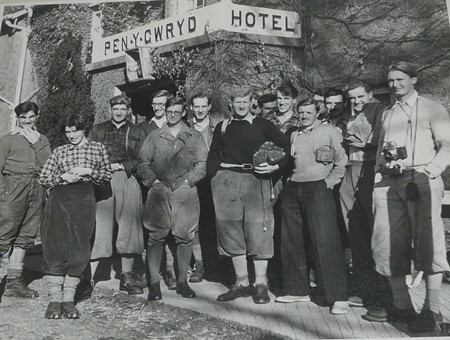
I finally made a visit to the Pen-y-Gwryd Hotel, just before the 60th anniversary of Hillary and Tenzing’s Everest climb. I’d heard that the names of the expedition members were written on the ceiling and sure enough, there they were, in the Alpine bar.

In the far corner of the ceiling I noted a familiar name, John Disley, who I’d listened to speaking as President of the Snowdonia Society at its recent AGM. A soft-spoken, quietly persuasive man but why was his name here next to Roger Bannister? No Everest connection as far as I can make out but great achievers nonetheless.

Both Bannister and Disley competed in the 1952 Helsinki Olympics with Bannister coming fourth in the 1500 metres and Disley winning bronze in the 3000 metre steeplechase. That same year John Disley set the record for the traverse of the Welsh 3000s ... ‘His time might well have been less than seven hours had not threatening weather prompted him to set off an hour earlier than planned.  As a result he kept arriving at his pre-arranged ‘pit-stops’ too early for his support teams.  He continued, without food or drink, until he finally collapsed on top of Pen yr Oleu Wen.  Fortunately, his support team on Carnedd Dafydd saw that something was amiss and came haring over to revive him....’ (extract from the excellent 14 x 3000 Cymru website).   Bannister went on to break the four minute mile in 1954 and Disley was BBC Wales Sports Personality of the Year in 1955.

After shopping at Cotswold Outdoors
In 1981 Disley was co-founder of the London Marathon with Chris Brasher and both were regular guests at Pen y Gwryd. There is a reference in the Daily Post (2003 May 3rd) which says Brasher had a group of walkers called Oboes, an acronym for On the Back Of EnvelopeS, which was inspired by Harold Tilman, the explorer who used to write the details of his expeditions on the back of envelopes. Roger Bannister was a member of this group and presumably so was Disley? At the next AGM of the Snowdonia Society I must ask him.

I’m really glad I made it to this shrine to Everest in the heart of Snowdonia. The 60th anniversary is on 29th May and there will be a reunion at the hotel that weekend for the families of the expedition of which there is only one survivor, Jan Morris, who was the Times correspondent covering the story.

Sunday, 31 March 2013

Icy Snowdonia

Successive freeze-thaw and blasting wind created spectacular sculptures. Clumps of icicles like pipes on a cathedral organ. Reeds in sheaths of ice. 

Gravity-defying windswept tendrils
of frozen water. 
Towards the top of Moelwyn Bach the snow, sealed in a shiny layer of ice, crunched beneath our boots as we followed the trails of snowboarders down towards the west.  

At the snow line a lone badger ran down the steep grassy slope into the drifts against the stone wall. We watched from high as it sought the exact spot, dug into the snow and eased its way through the square mesh of stock wire and a convenient gap between the stones.

This is what it sounded like underfoot:


And this is some shaky footage of the badger:


Sunday, 17 March 2013

Moelwyn goats alive and well


The Moelwyn gang are proud to announce the arrival of two kids which is twice as many as I saw last year. Each night the kids and the two adult females take shelter on a steep sided slope, thick with gorse, the sort of place where no-one is going to be able to sneak up unnoticed.  While the kids are hidden beneath, the adults munch away on the tips of gorse, one eye checking I’m keeping my distance.

This family has distinctive black and white markings whereas the group beneath the railway line are more mottled grey. Things are not so good below, down to one billy and three females with no surviving kids for at least three years.   

Friday, 8 February 2013

Wild Things in Snowdonia

The fourth episode of Wild Things explores plant life in Snowdonia looking into our rainforests, the deadly threat of Rhododendron Ponticum, and the plight of juniper berries on the slopes of Yr Wyddfa. It will be shown on Channel 4 at 8:30 pm Monday 11th February.

Dr Trevor Dines from Plantlife Cymru
With help from Plantlife, the Botanical Society of the British Isles, the British Lichen Society and the British Bryological Society, as well as Bangor University and Treborth Botanic Garden, Wild Things opens up a completely different view on the world around us. The series has been produced by Caernarfon based TV company CwmniDa. Last week’s episode looked into London’s plant life including ‘chewing gum lichen’.

Saturday, 19 January 2013

Iolo in the Vale of Ffestiniog


The third episode of Iolo’s Great Welsh Parks, recorded in and around Plas Tan y Bwlch, will be broadcast on Sunday 20th January at 17:35 on BBC Wales. Tune in to see what he finds. The fourth and final episode, filmed at Stackpole, will be broadcast the following week. Details of the programme and viewing via iPlayer can be found here.

The series was produced by Cardiff based Aden Productions who also filmed the series Wild Wales.

Friday, 15 June 2012

Nora hates flounders

Last weekend was bad news for the Dyfi ospreys and you can hear Emyr Evans describing the storm, the death of one chick and the dramatic rescue of the other, on Country Focus, Sunday 17th June.  I met up with Emyr on Thursday afternoon to make the recording and Ceulan, the rescued chick, had doubled in size over five days and was looking fit and well.

I will NOT eat flounder
But there were concerns that Ceulan had not been fed that day. Monty, the male osprey, had delivered a flounder to near the nest and left it draped over a branch. Nora, who started her life in Rutland Water, well away from strange-looking flat fish, ignored it while crows pecked away. By the time I left the wind had picked up, another storm was on its way and Monty had not delivered anything more appetising. What happened next?

The wonders of social media .... there was a tweet from @DyfiOspreys to say Monty had arrived with a huge grey mullet at teatime. See live streaming here. At the time of posting this item both mother and chick looked fit and well.

Emyr has written a brilliant article about the reserve which will appear in the next edition of Natur Cymru due back from the printers on 22nd June. The summer edition would have been a week earlier but for the fact that the printers, based in Aberystwyth, also got flooded! 

Friday, 8 June 2012

Bugs of Maentwrog

You never know what you will find and sometimes you will never know what you have found. I was busy weeding my garden when I sensed I was not alone, like a small periscope, some form of beetle kept rising out of a column in the grass. I made a short film of it and an expert suggested, from what little could be seen, that it might be a dung beetle.


But if I was a dung beetle I wouldn’t have chosen my sheep-free veg patch.  Does my beetle travel long distance to collect its dung? Yesterday I placed five balls of sheep poo just outside its hole and they are still there today ....  so, maybe it’s not a dung beetle.    

I was walking through the nature reserve with Molly (our dog) as she chased her frisbee through the bracken sending up a swarm of insects with the most enormous antennae. After sifting through many pages of my British Insects I feel reasonably confident that these were Nemophora degeerella (Adelidae).


Buff Tip
A bit further on was a Buff tip moth, perfectly camouflaged as a birch twig, but fifty metres from the nearest birch it was a bit of a giveaway on the bracken. 

Monday, 4 June 2012

Pied flycatcher of Maentwrog

It's non stop action at the pied flycatcher nest. I'm surprised they chose a nest so low down at eye level from our drive. A couple of years ago a startled squirrel ran away from my car into this hole and left its tail hanging out - a bit like head in the sand.

Tuesday, 29 May 2012

Grass snake in the greenhouse

Just watering the greenhouse .... it’s amazing what you might find! Elegant. Graceful. Beautiful. We might not have prize winning tomatoes but the grass snake is great. 

Field or bank vole?


Bird feeders are a great focal point but it’s not always the birds; this morning there was a small vole. Was it a field or a bank vole? The mammal society website is a good place to answer such questions.  As it was feeding on seeds, had reddish brown as opposed to greyish brown fur and a bicoloured tail (black on top, white below), I’m pretty certain it was a bank vole. They’re on the menu for tawny owls which have been very noisy these past few nights. They’re also on the stoat’s menu which recently has been seen through the kitchen window.


Sunday, 27 May 2012

Birdsong karaoke

At 05:30 we gathered close to the osprey nest where Hafod Garegog meets the Welsh Highland Railway; Sabine Nouvet, ecologist from the National Trust, was there to lead us on a dawn chorus. The birds had been in full voice when my alarm went off an hour before and by now they were settling down. Unfortunately this was not the case with the midges.

Sabine and the psycho sedge warbler
Sabine guided us through the woods and we quickly got the hang of the chaffinch, a downward warble with a bit of a churr at the end. Song thrushes were like opera singers rehearsing their notes. Chiff chaffs were easy but dull whereas the wren’s was a complicated song. The willow warbler was a bit like a chaffinch without the churr and the garden warbler was a bit more ‘bubbly’.

Sabine’s descriptions were great but it wasn’t always easy to pick out the described call or song from the rich mix of other woodland birds. I think I got the redstart and eventually I picked out the pied flycatcher though I’m not sure how I’d describe it. Back by the cars we looked across the fields with their reed filled drainage ditches listening to the aptly described manic song of the ‘psycho’ sedge warbler.

We said our thank yous and goodbyes and drove out along the mile or so of new tarmac (not quite sure why the council found this a priority). As I journeyed home I wondered how many songs I’d remember and how on earth I was going to learn about all the other birds.

But this was my birthday and my clever wife had bought me a BirdVoice. A little microphone type gadget on which you can play back either the calls or the songs of every bird I could imagine. Just press the gadget onto the call or the song of any of the 290 species of European bids contained in a laminated, pocket size field guide. I can see this is going to be really useful and much moré than a gimmick. It would have been handy for Sabine to use when trying to describe the calls.

There are lots of features and functions I’ve not yet discovered but you can find out for yourself by visiting the BirdVoice website.

Friday, 25 May 2012

Tawny owl’s revenge


Five evenings ago a young tawny owl was pushed and shoved out of the enormous Scots pine beside the house. A pair of crows, that nest at the top of the tree, dived onto the ball of fluff and feathers until Molly (our dog) and I chased them off. The bedraggled owl scrambled through the wire fence and crash landed into reeds below where once again the crows attacked. By the time we got there it was lying on the ground, exhausted, barely able to keep its eyes open. But when I approached, it gathered enough strength to fly fifty metres or so into the refuge of a nearby willow. We watched for a while and it seemed the crows had either not seen or lost interest.

Later that night there were two baby tawny owls crying out for food by the railway track at Campbell’s Platform. The next night they were a couple of hundred metres up the line. On the third night there were definitely three of them and I was able to stand in the middle of a triangle of trees as they pleaded to be fed. On the fourth night they were a bit further into the nature reserve and, maybe because it was a bit overcast and misty, the owlets started calling out much earlier, at about 7:30.

Last night we sat on our warm, midge-free balcony; it was bright and balmy and not until nine o’clock that we started to hear them, faint and far away to begin with. But by the time we’d gone to bed, the owls had moved into the same Scots pine, in the middle branches next to our open window, and were in full voice non-stop till dawn. This morning the crow family was looking just a bit tired!


Thursday, 17 May 2012

Ponticum bash at Bryn Gwynant


Snowdonia has a bit less ponticum now than there was at the start of the week; thanks to the Snowdonia Society, a few local volunteers and a large work party of students from Capel Manor College, Enfield. The students are studying countryside management and one of their modules is ‘uplands’.  Practical upland experience near to north London is not easy to find so each year the college brings twenty or more students to Snowdonia for a week of work experience.


As well as tackling rhododendrons they also lent a hand to the removal of sitka spruce saplings to help the rejuvenation of blanket bog following tree clearance.