Showing posts with label snowdonia society. Show all posts

Thursday, 30 April 2015

Ffridd for the Future – sabre planting at Dyffryn Mymbyr

Outside the farmhouse where Esme and Peter lived
Dyffryn Mymbyr is the hill farm immortalised in ‘I Bought a Mountain’, the Thomas Firbank book published 75 years ago and reprinted countless times. It’s a page-turner telling the story of Firbank buying the farm in 1931, along with thousands of sheep, and making a go of it, despite being a novice born in Canada.

A central character in the book and pillar of strength is Esmé, who he met and married a couple of years later. They went their separate ways during the war and afterwards Firbank gave the farm to Esmé where she lived with her new partner Peter Kirby. She went on to found the Snowdonia Society, and much later the Esmé Kirby Snowdonia Trust, campaigning relentlessly to prevent inappropriate developments spoiling the natural beauty of Snowdonia. After their deaths the farm was acquired by the National Trust in 2005 and since 2010 its two farmhouses have been let to people on a self-catering basis.

Sabre planting in a gully of a stream
Recent guests at the one farmhouse were a party of volunteers ‘sabre planting’ trees into the ffridd; that’s the steep hillside beneath the mountain wall above and the improved land beyond the road below. Sabre planting? The hills are alive with the sound of music and the bleating of hungry sheep who’ll nibble on anything they can reach, making it difficult to establish new trees. But if you plant a sapling at a 90° degree angle to the hillside, it makes it much harder to reach. Within a year or so the sapling develops a sabre shape as it bends upwards to the sun.

Simon Rogers, the National Trust's Community Ranger for North Snowdonia, showed us examples, scoring the volunteers’ efforts on a scale of 1 to 10. ‘That’s a 7 or 8, the gorse downhill from the sapling adds extra protection, but that one over there is a 3 or 4 – far too accessible if a sheep stands on that slab of rock’. Most of the planting to date has been in the gullies eroded by streams. These have steep sides, are partly sheltered from the ferocious winds and the grazing here is not the best i.e. the farming productivity is not being compromised.

Saplings are grown in pots, the consequent root ball giving them a greater chance of success, to a minimum height of 140cm. Sheep might be able to nibble at the lower branches but not the leading branches at the top. Nibbling or pruning the lower branches encourages growth into the leading branches which accelerates the growth into the safe zone.

The 5 year project, which is at the end of its first winter, will see the planting of 3,000 native trees; a mix of Rowan, Birch, Alder, Hawthorn, Blackthorn, Oak, Hazel, Willow and Crab Apple. These trees will help establish a bridge or woodland corridor between the wooded valleys of Nant Gwynant and around Capel Curig. 

Funding for this project has been provided in part by a generous donation from the Royal Oak Foundation (the American partner of the National Trust of England, Wales and Northern Ireland) to commemorate Fiona Reynolds’ time as Director General. Fiona was a close friend of Esmé and Peter and enjoyed many visits to Dyffryn Mymbyr. Funding has also been provided by the Esmé Kirby Snowdonia Trust.

Participants at the Wales Woodland Meeting visit Dyffryn Mymbyr

Sunday, 20 July 2014

The Ugly House Stud Farm for Bees

Ten virgin queens in hair curlers
Dare I say there’s a buzz at Tŷ Hyll? I love this photo of a proud beekeeper with ten virgin queens in ‘hair curlers’ which protect the queens from attack by a rival; the first new queen to hatch in any colony will kill potential competitors as soon as they emerge.

All ten of these virgin queens have now been placed in the Ugly House woodland in separate apideas (mini hives) along with a cupful of fondant and some young worker bees. After a couple of days the virgin queen in each apidea will have been accepted by the workers and can be released from the hair curler.

The virgin queens will be sniffing out the pheromones of the resident, roving drones at Tŷ Hyll and all being well, mating will take place in the next week or so. Each mated queen can go on to produce over a million bees during her life without the need to mate again – amazing!

If you’ve not yet been to the Ugly House (Tŷ Hyll) it is two miles out of Betws y Coed on the way to Capel Curig with an olde worlde tearoom, beautiful wildlife garden with five acres of idyllic woodland and enthusiastic beekeepers. More details at www.theuglyhouse.co.uk

Wednesday, 28 May 2014

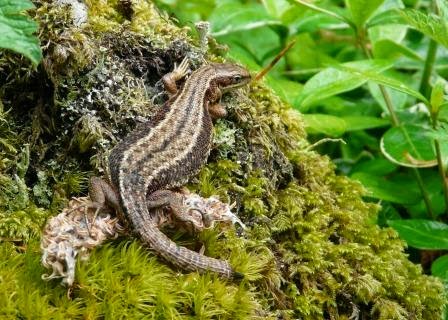
Beautiful Lizard at Ugly House

I dropped in to the Ugly House today to see what was new; thank goodness the food and the welcome were as good as ever. The gardens were looking brilliant and I could not resist buying £25 worth of bargains from the plant stand, all in perfect condition and meticulously labelled with pencil on wood.

On the path up to the compost toilet was a basking lizard, incredibly fat with a stubby tail; were baby lizards imminent? Or had it just eaten someone's sandwich?

Further into the woods were a series of beehive boxes marked THN1 and THN2 - Tŷ Hyll Nucleus hives? Apparently they have been left there on the off chance of attracting a swarm. The full scale hives at the top of the woods had increased from 2 to 3. In many places were sheets of corrugated metal and other materials, presumably to attract things like snakes?

In front of the tea rooms was Lisa, with an illustrated hive, taking out the frames to explain cross sections of what goes on inside. More unbelievable than science fiction but clear to understand.

If you would like to learn more about what goes on at Tŷ Hyll there is a bee friendly day on Saturday 31st May with candle making, seed sowing, tree decorating, bee hunt & quiz, bee-friendly gardening advice throughout the day and visits to bee hives and talks on beekeeping. Full details here.

On 30th June there is another event: A Pollinator Friendly Garden Day -
Trees and Shrubs for Bees. Details of this event are here.  

Tuesday, 1 April 2014

Geology of Gelli Iago – Llyn Llagi

After a brief introduction to rocks we headed out of the quarry near Gelli Iago, on the short cut road from Llanfrothen to Nant Gwynant. Our guide Clive Hudson, with long wooden staff in hand, looked a bit like Gandalf but without the beard.

Measuring the dip
His staff was not for conjuring up spirits or smiting rocks – this staff would help indicate the angle at which rocks dipped into the earth and another gadget was used to measure the angle of dip. At the start of our walk they were all dipping towards the south east and later on to the north west which meant we were walking through a basin – strong forces had squidged the rocks into a U shaped fold.

We walked over slate, crossed a slither of sandstone (and a bit of yellow tuff / volcanic ash) and were introduced to a dolerite intrusion; magma at high temperature and under high pressure, which had been squeezed between sedimentary rock and solidified slowly, deep underground. This rock has no slaty cleavage, tends to be blocky (breaking up into blocks) and covered in vegetation such as lichens.
Clive explains the process of bedding in sandstone

Dolerite was butted up against sandstone and, whereas in the past I would have called them all rocks, I like to think that I could now tell the difference. Sandstone is built from layers of sediment accumulating underwater and this was obvious to see with larger granules in places, where stronger currents had carried heavier bits. On the face of some rocks we could see the ripple effect, with heavier granules on the ridges and finer sediments in the troughs.

This area is obviously a well used outdoor classroom; every now and again we would notice a chipped off piece of rock where budding geologists had taken a sample. Newly exposed rock is a very different colour to the weathered rock.

Not a contact lens but a fossil!
Along the way through the basin, Clive turned over a rock to illustrate some fossils. Nothing with great jaws, wings or long tails but a few tiny, finger nail shaped hollows formed by seashells. Upside down (round side on top) shells are less likely to be dislodged by moving water so we could assume which way up this boulder had been created. As we got closer to Llyn Llagi we found what we were looking for, the dolerite rocks coming up at the far side of the basin.

From the shores of Llyn Llagi we stood on a hollow-sounding structure of slate in the middle of a bog which we surmised to be a platform for drying peat. But who wanted the peat up here? It was handy to have Kathy Laws in our party, the archaeologist from the National Trust, to point out the site of an iron-age settlement just a hundred metres or so away – maybe they would have needed a supply of peat.

The buoys in Llyn Llagi are part of the monitoring of this and 20 other lakes in Britain to measure acidity. Since 1988 the acidity of Llyn Llagi has fallen with PH rising from about 5.3 to about 5.9 – the main factor being the reduction of acid rain caused by sulphur dioxide from coal-fired power stations. The other lake monitored in Snowdonia is Llyn Cwm Mynach.

From here we walked to the top of a microgranite sill to eat our lunch beside a dolerite erratic. I’m not sure I could identify microgranite – it’s like dolerite but formed with the addition of quartz. On a sunny day it made for a great picnic site.

Our last mission was to climb to the top of Castell, a rhyolite intrusion - a ‘volcanic plug’. Clive explained the different viscosity of lava (which is magma that has broken through the earth’s surface). Volcanoes erupting on, or close to the edges of continents have sticky lava whereas in the open seas they have thin, fast flowing lava, which is why Hawaii is the shape it is. When lava spewed out of Castell it was the sticky stuff that stayed upright and slowly moulded over time. The rhyolite was a light, whitish colour with lots of fragments solidified in wavy bands.

On top of the volcano
It was a wonderful day led by Clive and organised by the Snowdonia Society. I feel I know a lot more than when I started but the number of questions buzzing around my mind makes me realise the extent of my ignorance on this fascinating subject.

Clive Hudson is an enthusiast for local pre-history and maybe organising a day school to look into subjects such as: flint technology and lime bast string and other cordage. Another possibility is the extraction of birch bark tar which was the glue to stick flint onto shafts; Clive’s prototype involves a biscuit tin and a baked bean tin in a fire! If you would like to know more or take part in an interesting day please contact Clive at cliveshan2@gmail.com

How it all happened over millions of years

Sunday, 27 October 2013

Snowdonia Marathon - Feedstation Five

Snowdonia hosts spectacular sporting events such as the Snowdon Race, Étape Eryri, the Snowman Triathlon and yesterday was the Snowdonia Marathon. Staging these events involves a huge volunteer effort and feedstation five, on the way into Beddgelert, was staffed by volunteers from the Snowdonia Society.

We followed our instructions laying out refreshments in the prescribed sequence of water, squash, isotonic and gel. 75 minutes after setting out from Llanberis the front runners, with police escort and motorbike mounted cameraman, raced past totally ignoring our goodies. For the next ten minutes runners arrived in ones, twos and threes but then it was rush hour; so many customers it was difficult to maintain high standards of service. The knack of placing a polystyrene cup into a runner’s tired and moving hand is a skill that comes with experience, better practised with waterproofs.


It’s a popular event, sold out six months in advance, with good humoured runners, lungs full of invigorating mountain air. An event which is a welcome out of season boost to the local economy with many competitors travelling and staying the weekend to take part.  Thank you to the runners, the volunteer marshalls, the sponsors and especially to the organisers who make it happen and last year donated £14,000 to local good causes.

This year's winner was Rob Samuel, from local club Eryri Harriers, with a time of 02:43:50.


Sunday, 15 September 2013

Dry Stone Walling, a competition with confoundingly round stones

Friday was miserable, Sunday was stormy but on Saturday sunshine beamed down on the righteous as they toiled away in the Snowdonia Society’s 30th Dry Stone Walling Competition. In recent years the competition has been held near Beddgelert, where the stones are flat, but this year it was at Egryn, just north of Barmouth, where the stones are confoundingly round.

At 09:30 competitors dismantled the wall which was marked out in lengths of six feet for professionals and four feet for amateurs or beginners. A master line was stretched along either side at the base and profile bars banged in to guide the required taper as the wall rises.

Two judges patrolled, conferred and made notes on their clipboards as they marked each element of the walling. Up to 20 points for foundations, 20 for first lift, 5 for throughs, 20 for second lift, 15 for coping, 5 for hearting and 10 for line and batter. There were 5 points for ‘general’ and I’m not sure what they were looking for; maybe good manners?

Volunteers served chunky baps, cakes and mugs of tea out of the kitchen gazebo to maintain energy levels. Spectators came and went and generally came back again; it really does make a great spectator sport.

By 17:00 the wallers had finished, then the judges totalled up the scores and everyone gathered around for the prize-giving presentation. Brian Evans from Corwen won the professional section picking up a cheque for £120 plus the trophy. Terry Thomas from Nottingham won the amateurs section and Rhys Roberts from Tywyn won the beginners section.
Brian Evans receives the trophy from Ed Bailey

Edmund Bailey, President of NFU Wales, presented the prizes and said after the event ‘I was particularly delighted that there was a beginners section so that the old rural skills can be perpetuated. My concern, following the withdrawal of stone walling from the basic agri-environment scheme, is that fewer youngsters will have the opportunity to gain the knowledge and then the repeated practice to become competent wallers.’

The competition was part of the Egryn Heritage Open Day, organised by the National Trust, with many activities including apple pressing, sheepdogs in action, vintage tractors, talks on historic houses and on field names, walks to the iron-age hillfort and guided tours of Egryn.

Edmund Bailey also said ‘Egryn is in such a fine position with all the features of this area so prominent, especially Ardudwy's extensive field systems, that it would be difficult to imagine a better venue. The house and the other attractions added to the enjoyment we all experienced’.


Friday, 13 September 2013

Dry Stone Walling Competition at Egryn on Saturday 14th September

It’s the Snowdonia Society’s 30th Dry Stone Walling Competition on Saturday 14th September and will be held at Egryn, just north of Barmouth. This is what the competition looked like a couple of years ago:


As well as relaxing watching people building stone walls you can:
  • Have a guided tour of the historic house
  • Enjoy the spectacle of vintage tractors and engines
  • Take a guided walk to Pendinas, the iron-age hillfort
  • Learn about the Egryn Diamond apple
  • Taste the juice of apples out of Richard Neale’s apple press (bring your own apples)
  • Listen to Rhian Parry talking about the field names of Ardudwy
  • Meet lots of friendly people in stunning scenery
In case you have stumbled across this post and want to know the results, these can be seen here.

Wednesday, 11 September 2013

Brood! We have brood!

Towards the end of August two mini hives, each containing a virgin queen, a cupful of worker bees and some fondant (food), were installed in a secluded area of the woodlands at Tŷ Hyll. The idea being that the virgin queens would mate with drones from nearby hives and go on to produce a pure breed of native ‘northern European dark’ bees as opposed to more exotic species less suited to our climate.

This was our first go at mating and there was much anticipation two weeks later when we opened the mini hives to see what had happened. Pete Barrar, from the National Beekeeping Centre for Wales, eased off the roof and lifted out the empty queen cell. It was good that it was empty but where was the queen? Had she been accepted or had she been killed by the other bees? Had she mated and started laying eggs?

Lots of bees were buzzing away as we gazed on through the mesh of our bee suits and then Pete exclaimed ‘Brood! We have capped brood!’ It was a bit like Houston saying ‘we have lift off’. Bees crawled all over the frame and as we watched the queen, with her body longer than the others, she reversed into a cell to deposit an egg, but at that moment a worker walked on her head and put her off her stride.
Brood! We have brood!
Peter Barrar, National Beekeeping Centre for Wales

Frames were delicately reinserted into the expanded polystyrene hive, not very aesthetic but they are strong and with good insulating properties. A slab of fondant, which looked like sticky icing sugar, was cut out of a pack and placed at the end of the hive. Then a plastic sheet was laid over the tops of the frames to encourage the bees downwards so that the roof could be replaced without squashing anyone.

We moved to mini hive number two, perched on a pedestal with a stone on top to weigh it down. There were lots of bees inside but no brood to be seen. This queen was a couple of days younger than the other and maybe she needed a bit more time? Or maybe the process hadn’t worked? Either way we were all elated that we had proved the point that we could rear queen bees.

Pete explained that the queen would have mated maybe fifteen times (i.e. with fifteen drones), over the course of one to three nuptial flights, until her spermatheca was full. This holds something like six million sperm which the queen selectively releases during her productive life. Unlike species from warmer climates such as the Mediterranean, which lay eggs at full speed throughout the year, native queens reduce the number of eggs to reflect the climate and the amount of available forage. In the summer our queen could be producing up to 2,000 eggs per day.

Our mated queen will be used to requeen a colony that needs a new queen, to keep that colony going through the winter months. September is too late in the season for a queen to create a new colony to be strong enough to get through the winter so next year we will start the mating much earlier.  ‘A swarm in May is worth a load of hay; a swarm in June is worth a silver spoon; but a swarm in July is not worth a fly’ .... for it is then too late to store up honey before the flowers begin to fade.

Thank you to everyone who has helped to make this wonderful act of creation possible and establish a process which will significantly help local beekeepers, native bees and the knock-on benefits of pollination.

Sunday, 26 May 2013

Harlech beach clean and feast

A dozen volunteers got stuck into the Portmeirion end of Harlech beach collecting all kinds of rubbish; orange string, green string, blue ropes, chunky ropes, plastic fish netting and so on but maybe not so many carrier bags as in previous years? Or is that wishful thinking that the bag charge is changing behaviour?

Pick-ups ferried sacks of rubbish to the car park with deep, drifting sand making it difficult to exit from the beach. Charging into the dunes the white 4x4s looked as though they were taking part in a trans Sahara rally.

By mid-afternoon sausages were sizzling over charcoal and wildlife guide Brian Macdonald was scanning the shimmering sea through his scope. Volunteers reappeared; must have been the long distance smell of sausages. They brought with them the odd bit of wildlife washed up in the strand line which Brian helped identify. I now know what to call that potato looking thing, a ‘potato urchin’ of course.
Jenny master chef

One of Brian’s specialities is to serve beach suppers with his guests helping gather edible seaweed, shellfish and driftwood for the fire. Today he brought mussels from Llandanwg placing them on racks above sawdust in a smoker sat on the barbecue. While they were smoking away he served mugs of crab bisque, made from one third shore crabs and two thirds edible crab. Chilled white wine was poured and then the mussels were ready, shells split open. Scooping out the orangey flesh with one half of the shell they slipped down a treat. Definitely not al dente.

smoked mussels
All blue sky, Snowdon clear, good company, good food and not a scrap of litter to be seen – job well done. Thank you to you volunteers who gave your time, thank you Jenny and the Snowdonia Society for organising the event, thank you Snowdonia National Park and Natural Resources Wales for laying on transport and thank you to Brian for a gastronomic delight. 


You can find out more about Brian’s wildlife guiding on his website. If you would like to join a Snowdonia Society volunteer event see the website for opportunities. 7th June is footpath maintenance on Snowdon and 15th June is dolphin surveying from the Great Orme.

If Brian was on Desert Island Discs I think he'd take the scope

Monday, 29 April 2013

Rearing Queen Bees

We are rearing queen bees in the woods of Tŷ Hyll (the Ugly House) to sustain local bee-keeping in the Conwy valley.  To explain the process we need to set the scene as to what goes on in the hive and who does what. If you know all this already just skip to the final section.

There is one queen bee in each hive or colony of honey bees and all she does is lay eggs, maybe 2,000 a day for her 2 to 3 years of productive life. Fertilised eggs will become workers (females) or queens; unfertilised will be drones. Within a typical hive in summer there are about 2,000 drones, whose sole purpose is to mate with a virgin queen, and up to 60,000 workers, who do everything else in organised social harmony.

Image courtesy of NASA
The life of the worker bee
When a worker emerges into the darkness of the hive she will instinctively clean out her cell ready for another egg to be laid or for food to be stored. Learning by touch from older workers, she will help clean the hive, preparing cells for new eggs (brood) or for nectar and pollen (stores).

At 3 days she is a brood nurse, using stores to feed newly hatched larvae, and taking her turn to feed queen larvae with royal jelly, which she is now old enough to secrete. She will also attend the queen, guiding her to stores to feed and to newly cleaned cells for her egg laying.

At 6 days she is ready to receive and store food and water brought in by older bees, producing enzymes to process nectar into honey, and fanning with her wings to reduce the water content.

By 12 days she can secrete wax to repair or make new comb cells, to cap brood cells when larvae are ready to pupate or store cells when full of pollen or nectar.

By three weeks she is mature enough to explore the world outside the hive, initially guarding the entrance to warn off intruders. She takes short trips to familiarise herself with the surroundings, before finally becoming a fully fledged forager, venturing further and further afield.

After about 6 weeks the female bee has literally worked herself to death, possibly having flown 500 miles in her foraging lifetime. She will die sooner if she is forced to use her sting in defence.
Margaret and Pete with the first hive

Rearing Queen Bees
Eggs, from a colony at the National Beekeeping Centre for Wales, are grafted into artificial queen cups which look like queen cells constructed by worker bees. Up to sixteen of these on a special frame are put into a hive where the workers will feed the hatched larvae with royal jelly before capping the cells. Artificial protectors are then placed over each cell as protection from the colony queen and from each other.

Each newly hatched virgin queen is brought to Tŷ Hyll and placed in a mini-hive (apidea) with a handful of workers, mini-frames and a supply of food. The queen remains within her protection for a couple of days until the workers have accepted her smell, otherwise they would attack her as an intruder. Once we release the virgin queen from her protection she is eager to mate and start laying eggs to build up her colony.

Meanwhile we have been creating a plentiful supply of drones by placing frames within our hives which have the larger size cells into which the queen knows to lay (unfertilised) drone eggs.  Once hatched and mature these drones roam around the woods until a virgin queen detects their pheromones and flies up to mate with as many as possible on this one and only occasion. Their work complete, the drones die and we transfer the mated, laying queen to a nucleus hive, holding frames with stores of food plus workers from the main hives, ready to be supplied to local beekeepers. Alternatively, the laying queen can be supplied on her own for hives without a queen.

The vacated apidea are then prepared for the next batch of newly hatched virgin queens and the whole process may be repeated six times per season, creating up to ninety queens, each of which is capable of producing over a million eggs!

For more information about the work visit www.theuglyhouse.co.uk

Sunday, 24 March 2013

Wild daffodils – Snowdonia Society expedition

I was hoping to see wild daffodils on the Snowdonia Society's guided walk on 26th March but due to deep drifts and freezing temperatures there was not a wild daffodil to be seen. 

In case you wanted to know, this is what we have missed out on:

Wild Daffodils - photo by Rod Gritten
Yellow daffodil trumpets are a ubiquitous sign of Spring, not only in gardens but also on roadsides, in hedgerows, in fields and in woods. Yet they have none of the exquisite beauty of the rare wild daffodil, the true national emblem. Although our native daffodil is in serious decline, there are places where it has prospered, with a little help from its friends. Rob Collister and Rod Gritten tell the story of a wild daffodil recovery in the hills above the Conwy valley, and the possible roadside return of the native.

One day towards the end of March my wife, Netti, and I were joined by Rod and Julie Gritten for a walk up a wooded hillside above the Conwy valley. It was a glorious sunny day, warm and still, even though there was snow on the hills above and a skim of ice lingered on shady puddles. As we walked across some ffridd pasture, admiring wide views down onto the river Conwy, suddenly we glimpsed a haze of yellow across a small dry valley, through leafless branches on the slope opposite. Over the next hour or so we found wild daffodils growing everywhere over an area of about 400 x 300 metres that could perhaps best be described as wood pasture, even forcing their way in isolated clumps through a thick blanket of dead bracken. But they seemed at their most prolific in damper or shadier spots where the bracken had failed to establish itself. In such a setting we could understand exactly why Wordsworth was so entranced. I think both Rod and I felt a degree of pride as well as pleasure at the spectacle, for it represented the fruition of a successful conservation project.

For me, the story began a long time ago. One day I was out wandering the ancient field systems of the northern Carneddau, investigating its wealth of prehistory, when I came on a green notice board that said “Please do not pick the wild daffodils”. It had been erected by the North Wales Naturalists Trust (now the North Wales Wildlife Trust), but it looked old and faded even then, over 30 years ago, and the rotting stile over the wall seemed on its last legs. With anticipation, I crossed the wall but found not a trace of any daffodils. Over the years that followed the sign grew older, the lettering ever fainter, and crossing the wall increasingly acrobatic, but I did discover a damp corner where a number of daffodil leaves could be found but always nibbled by sheep, with never a flower to be seen.

Then, one spring about seven or eight years ago, to my surprise and delight, I discovered a sheltered re-entrant awash with yellow and took a number of photos to record the scene. However, it proved to be a one-off and over the next few years there were never more than two or three blooms at best to be seen, and often none at all. The land was so smothered in bracken that succulent green shoots must have been manna from heaven to hungry sheep. It seemed to me that if the sheep could be taken off this piece of land for just a few months every year, these delightful plants, smaller and more delicate than their garden counterparts, could thrive rather than simply survive. But how to achieve that? No farmer would sacrifice grazing, however poor, for flowers. As luck would have it, I started to go climbing on summer evenings after work with Rod Gritten, then Senior Ecologist for the Snowdonia National Park. Chatting on a stance halfway up a crag – it may have been Clogwyn y Wenallt in Nant Gwynant – I mentioned the daffodils and Rod’s response was immediately interested and positive. I’ll let him take up the story……

Rod continues…
The notion that wild daffodils, or to give them their rather clumsy Latin name Narcissus pseudonarcissus ssp pseudonarcissus might still survive in the wild was intriguing. Rob took me to have a look late the next January and sure enough, tiny green spears of emergent leaves were forcing their way through the frost encrusted bracken litter. But each one I examined showed the tell-tale nibbling by sheep and it was clear that none of these plants would survive to flower.

At this time, the National Park had its own very successful agri-environmental scheme, Rhaglen Tir Eryri. I discussed the situation with one of the scheme’s Field Officers and he agreed to investigate the possibility of funding a rescue plan. It took some time for me to discover who the landowner was but I was much more successful in tracking down the history of the Wildlife Trust’s involvement. The site had been well known and protected by the Trust but historical changes had occurred: management neglect and decades of winter grazing by sheep had all but obliterated this rare patch of a truly native daffodil.

To cut a long story short, Rhaglen Tir Eryri discussed the management of the site with the landowner, who agreed to let the scheme pay for a new stock-proof fence to be erected around the site, two new stiles and some judicious bracken spraying. The landowner was also in full agreement to exclude his stock during the late winter/early spring. The rest, as they say, is history. A very special place, tucked away off the beaten track, is now awash with the subtle yellow of this lovely plant with its blue-green leaves and diminutive form.

But that is by no means the end of the story. I had been closely involved in a number of high-profile road schemes in the Park being undertaken by Gwynedd Highways and the Assembly Trunk Roads Directorate, and the issue of bulb planting on the new verges frequently arose in the Environmental Liaison Group meetings. I have always felt quite uncomfortable about the ‘urbanisation’ of roadside verges in the wild scenery of the Park caused by the indiscriminate planting of large blousy daffodil cultivars. Why not investigate the possibility of arranging for a nursery to collect seed from the native daffodils in the Conwy valley, grow them on to the bulb stage and sell them back to the Highway Authorities for roadside verge planting? This is a long-term commitment since it takes some seven years to establish viable bulbs from seed but it is not only good for nature conservation but is also good for the local economy. As I understand it, this idea is receiving serious consideration by the Park and the Conwy wild daffodils are currently being DNA tested to make sure they are of pure stock. Let’s hope so – they certainly have all the characteristics of our native daffodil.

Rod Gritten was the Senior Ecologist for the Snowdonia National Park for many years until he left in 2008 to set up his own ecological consultancy. He now specialises in plant surveys.
Rob Collister is a mountain guide, these days working mostly in Switzerland and north Wales.

Cennin Pedr Conwy

Sgwrs rhwng dau ddringwr ar wyneb clogwyn yng ngogledd Cymru sbardunodd y gwaith i achub y genhinen bedr wyllt yn Nyffryn Conwy. Nid oedd angen hysbysfwrdd yr Ymddiriedolaeth Bywyd Gwyllt leol i rybuddio pobl rhag pigo’r cennin pedr ar y ffridd - roedd y defaid yn sicrhau nad oedd blodyn i’w weld fyth ar y safle! Yn ffodus daeth Rhaglen Tir Eryri, cynllun a ariannwyd gan arian Ewropeaidd, i’r adwy. Ar ôl codi ffens newydd, trin y rhedyn a chael cytundeb y ffermwr i dynnu’r stoc oddi ar y tir yn ystod y gaeaf a’r gwanwyn mae’r llethr bellach yn garped o liw melyn ym mis Mawrth.

Ac mae’r stori’n parhau. Oherwydd gofid un o’r dringwyr, a ddigwyddai fod yn ecolegydd gyda Pharc Cenedlaethol Eryri, am yr arfer o blannu cennin pedr gardd ar ymylon ffyrdd newydd fe awgrymodd y gellid meithrin hadau cennin pedr gwyllt Conwy er mwyn eu plannu drachefn yn fylbiau ar ymlyon ffyrdd Eryri. Mae’r syniad wedi cydio ac mae profion DNA wrthi’n cael eu cynnal ar y cennin pedr hyn er mwyn gweld a ydynt yn rhai pur.

Saturday, 2 March 2013

Celebrate, enhance, protect

When I think of the Snowdonia Society (Cymdeithas Eryri) these are the three words that come to mind - celebrate, enhance, protect. In pulling together a presentation to set the scene as to what we are about, it was easy to think of examples and images to illustrate the celebrating; guided walks to see wild daffodils, evening talks on local crafts, the dry stone walling competition and so on. Enhancing was also simple; footpath maintenance, planting trees, removal of invasive species and even campaigning for a bus timetable!

But when it came to protecting (‘gwarchod’ yn Gymraeg) I had to pause. If you succeed in protecting, there is nothing to point to apart from the absence of the threat. Alternatively, if the actions to protect were not successful, there is a blot on the landscape that you don’t really want to draw attention to.

Finally I thought of an example and here it is in two pictures .... the pylons going underground across ‘traeth mawr’ and the most beautiful view of Snowdon from the Cob. That’s a good example of protecting something priceless.


Friday, 1 March 2013

Red army on the march

Fifteen years ago Anglesey’s red squirrels were close to extinct, about 40 adults, but today there are estimated to be more than 500. I don’t know whether it’s getting a bit crowded on the island but adventurous reds are storming the mainland, thought to be crossing the Menai Strait on the lower deck of the Britannia Bridge.

Craig Shuttleworth talking to Radio Wales Country Focus
Photo  BASC 
I joined a group of volunteers in the National Trust woodlands of the Vaenol, overlooking Plas Newydd, for a briefing session with Dr Craig Shuttleworth of the Red Squirrel Trust Wales. My fellow volunteers were mainly members of BASC (British Association for Shooting and Conservation) and that gives a clue to the success of the reds. Part of the BASC Green Shoots initiative.   

Reds and greys can’t coexist – the larger greys from America out-compete the reds for resources. They also carry a disease which is lethal to the reds. For the successful restoration of the Anglesey population a pre-requisite has been the systematic killing of the greys. A population of over 3,000 is now thought to be less than 30. Not everyone approves! A survey indicated 65% approval for culling, 20% no opinion and 15% against.

Culling is by shooting or by trapping and Craig demonstrated best practice with a trap. On the day nine traps were inspected, two contained reds, which were released and scampered free into the trees, and two which contained greys. All traps had been covered with a sheet of black plastic, to keep the animals dry and warm, and covered with leaves for camouflage. To deal with the greys a hessian sack was placed over the entrance to the trap and when the door was opened, the squirrel ran to the far corner of the sack where it was held tight and swiftly despatched with a cudgel to the head. Brutal but quick. 

Red squirrel ready for release
Photo BASC
It’s difficult to know how many reds are present in this bit of woodland but maybe about 20? There are other pockets of reds, including some pioneers in the woods near  Bethesda, right on the edge of Snowdonia National Park. Esmé Kirby, founder of the Snowdonia Society, and who galvanised people into action for the red squirrels, would be very pleased with this progress. The intention is to cull around the Menai Strait and inland to prevent  greys returning to the island and encourage their spread up the Ogwen valley. When will they be in my garden in Ffestiniog? 

Many thanks to the BASC for organising this event. Walking back to the cars I was busy chatting and missed the red that ran across our path.

If you want to know more about the red squirrel project there is a very informative website. You can also listen to Craig talking on the Country Focus programme on Sunday 3rd March. 

Sunday, 24 February 2013

Ugly House Beautiful Benches

The walk around the woodlands is a twisted maze of narrow paths, bluebells pushing through and late February snowdrops in bloom. Birds aplenty, not yet competing for nests. Freshly coppiced hazel has made way for more sunlight and opened up the views; the old walls of a terraced garden now plain to see but who built them and when?

Bob the Bench Builder

So much to soak up it’s best to dawdle, no need to close your eyes to think you’re in heaven. And it’s just got better - now you can dawdle on a seat.

Bob 'the Bench Builder' Cole, former chair of the Snowdonia Society, treated us to a woodfest of green bench-making. Using bits of trees from recent thinning and pruning, all part of a Better Woodlands Wales scheme, a series of benches has been built with the help of volunteers.

Tim the tearoom laid on a special lunch for the Friends of Tŷ Hyll (the volunteers) – real tea leaves needed the tea strainer and the home baked cream-jammed scones hit the spot. If you’re a member of the Snowdonia Society you get a 20% discount at this woodland oasis. You also get a generous 20% discount at Cotswold Outdoors. It pays to join the Snowdonia Society! 


Wednesday, 6 February 2013

Polecats and Corks

Two outstanding wildlife films will be shown on Wednesday 20th February starting 7pm and introduced by their creators.

MASKED RAIDERS The Polecat Story.  Created by Geoff and Heather Gartside and narrated by Mike Salisbury. This dramatised film tells the story of how, by the end of World War One, polecats were brought to the very brink of extinction in Britain. What could have caused such a rapid decline and what is happening to the polecat today? The answers are intriguing!

Using dramatised re-constructions and little seen archive material, this film beautifully documents the intense, long running battle between gamekeepers and polecats. It's what almost caused the polecat's demise as a British mammal and their recovery from that dire situation is a story of survival against the odds.

CORK - Forest in a Bottle. Created by Mike Salisbury and narrated by Monty Don.  The Cork Oak forests of Southern Portugal, the Montado, form one of the most significant and beautiful wildlife areas in all of Europe.  Without coming to any harm, Cork Oaks can be stripped of their bark every nine years to be made into the billions of stoppers we use to close our wine bottles. The economic value of traditional cork production has protected this ancient landscape and its rich wildlife until today but more and more use of plastic stoppers and metal screw caps could bring huge changes.

This film follows a season in the remarkable natural history of the Montado and in the life of cork farmer Francisco Garrett who cares passionately about conservation.  He asks whether the future of so much wildlife could rest on the seemingly trivial choices that we might make as consumers of wine.

Wednesday 20th February at Y Caban , Brynrefail, Llanberis.

Two-course meal: £10 and booking is essential. Serving 6pm.
Watching the films: donations on the door (suggested minimum donation £3 for members, £5 for non-members).

Contact Snowdonia Society for more details: 01286 695498 info@snowdonia-society.org.uk

Friday, 18 January 2013

Snowdonia Society business membership – a badge to make a difference

I’ve always been a bit sceptical about badges, probably scarred by years of big company ISO 9000 tick box certification.  Do quality grading schemes really make a difference?  So many people have these types of badges but how much are they worth to the businesses and their potential customers? Certification or quality management assurance is certainly big business and big bureaucracy.

But here’s a badge with a difference - Business Member Snowdonia Society (Aelod Busness Cymdeithas Eryri). Membership is aimed at any business which shares the goals or objectives of the Society.

RAW Adventures, which organises mountain activities, is one of the first to become a Business Member. It is run by local mountain leaders Kate and Ross Worthington. Kate said .....’ we are looking forward to continuing to support and promote the outstanding work that the Society does. Both Ross & I have been individual members for a number of years, even before moving to the area, and have enjoyed some great days on events such as the Snowdon litter pick. We love sharing the Snowdonia mountain environment with friends and family as well as for work. We feel that being business members is a great opportunity to give something back to an area that is very dear to our hearts’. 

Membership fees are £50 a year in return for which the business gets publicity on the society’s website and in the magazine, multiple copies of the magazine and use of the logo. Members are able to show they care about Snowdonia’s future and raise awareness of their business amongst like-minded environmentally aware people. Full details of the scheme can be found here.

Another new recruit is Trigonos, a residential centre for educational and training events, workshops and retreats based in Nantlle. ...’The qualities of the Snowdonia National Park are an important factor drawing people towards Trigonos. Those qualities are taken for granted but have only been maintained through the commitment of generations who love Snowdonia. If we benefit from the Park then we should do whatever we reasonably can to maintain its integrity and character. Being a business member of the Society is a significant step to that end. By supporting the Society and the Park in general we are also helping to maintain and increase long-term employment for local people. The two objectives are totally compatible.’

Coming clean ... as well as working for Natur Cymru I also work for the Snowdonia Society so I am a bit biased. If you know of any business that might be interested in becoming a business member of the Snowdonia Society please forward this to them. Many thanks. Huw


Sunday, 13 January 2013

The birds and the beers


Once or twice a month the Snowdonia Society (Cymdeithas Eryri) organises social events for members of the society and the first event of the year is on Saturday 19th January. Rhys Jones will lead a midwinter morning walk around Llyn Bach and along the Porthmadog Cob where we hope to see lots of wildfowl and waders that winter on the Glaslyn Estuary. This will be followed by a traditional pub lunch with a range of real ales at The Ship.

If you would like to come along please contact Frances Smith on 01248 685498 or by email to frances@snowdonia-society.org.uk

Thursday, 3 January 2013

Green buttons at Waitrose


Waitrose Menai Bridge puts up £1,000 a month for good causes which this January includes the Snowdonia Society. Just pick up a green button at the checkout and pop it into the middle column. At the end of the month the money will be divided between the three selected good causes which also include CPRW (Campaign for Rural Wales) and a local Beavers group (which is nothing to do with mammal reintroductions).

They do this at other Waitrose stores around the UK which are a scarce commodity in north Wales; the nearest ones to Menai Bridge are across the border in Cheadle and Sandbach.

Apart from being a good cause it’s a great store so if you’re passing please call in and vote. As I have just started working for the Snowdonia Society I am of course biased! 

Level pegging at the start of day 3

Sunday, 18 November 2012

Crib Lem to Carnedd Dafydd, a scabrous walk

From a roomy layby on the A5 just north of Llyn Ogwen we walked up a farm track, got wet feet in a bog, then dropped steeply down until we faced the Glyder-like scenery. Miniscule figurines of early morning walkers on the horizon gave a sense of scale to this raven patrolled fortress. Our route into the clouds was Crib Lem, every bit as exciting as the north face of Tryfan but without the crowds.

Who or what was Lem or Glem? The discussion was inconclusive though someone spoke of a northern expression for being cold and maybe this was a Viking word we had subsumed. If you hung around contemplating too long it quickly became glem with a puddle of bog in your boots.

[I've now had it explained to me: Lem is the mutated version of Llym which means sharp or severe].

Our guide Rob Collister led us skilfully up the scrambly ridge until we reached the top of Carnedd Dafydd. We could hear the chough calling out and then it broke through the cloud and continued on its way.

Sitting in the summit shelters we were reminded that carnedd means cairn as in burial and that Dafydd was the younger brother of (neighbouring Carnedd) Llywelyn, the last prince of an independent Wales. His daughter was Gwenllian and her name has now been given to what was previously called Carnedd Lladron or Carnedd Uchaf. 

From the top we strode out along the ridge towards Pen yr Ole Wen, with sunshine illuminating Llŷn, and paused to look at the vegetation beneath our feet. Was this montane heath? It’s very rare and, apart from Pumlumon, Snowdonia is the most southerly occurrence with our best bits in the Carneddau. It has suffered from too much nitrogen, excess sheep grazing and consequent dung and urine. With reductions in sheep numbers there has been a slight recovery but declines of some plant species. CCW wanted to establish whether it was sheep or walkers that are the problem and placed a camera on the ridge which clearly showed that walkers generally stick to the main path and that the sheep are the problem. There are very few sheep but for some reason they always tend towards the ridge, maybe that’s where they escape the midges? We had a brief discussion on rumours that there might be fencing to exclude the sheep and how ugly that would be in this wild part of the mountains. I will try and find out whether there is any substance to this rumour.

As we veered downwards Rob warned us to take care across this ‘scabreuse’ terrain – with a word like that I knew I was out walking with an international mountain leader. Definitely French and its English equivalent, scabrous, meaning ‘rough and covered with scabs’. Sort of appropriate for the bloody deaths of Llywelyn and Dafydd.

Events such as this are among the many reasons for wanting to join the Snowdonia Society and, with Christmas coming up, the 20% discount at Cotswold Outdoor is much appreciated. Many thanks Rob.

Thursday, 1 November 2012

Clearing the dunes at Fairbourne

I have idyllic memories of sunshine and running barefoot in the dunes; but best not to do so near the Point at Fairbourne where there are protruding strands of wire and fencing. This Saturday, 3rd November, a team of volunteers will be tackling the problem to restore the dunes to the spectacular beauty spot many local residents and visitors enjoy for dog walking and bird watching.

Volunteers will enjoy a free ride on the Fairbourne Railway to the end of the line where the work is most needed, all are welcome so do get in touch if you would like to help in this clear-up campaign and experience this very special narrow-gauge railway for yourself! This is what it looks like on the railway:


Jane Byrne, vice-chair of the Fairbourne Railway Preservation Society explains, “The Fairbourne Railway has run through magnificent scenery along the sea front in Fairbourne since its origins as a horse-drawn tram service in 1895.  In 2010, the Railway gained charitable status and in large part is now staffed by volunteers from the FRPS.  In the 1980s, barbed wire fencing was put in to protect certain areas of the dunes and to hold sand back from the rails.  Marram grass now serves the purpose of retaining the sand and the fences have gradually broken or rotted and present a hazard to people and wildlife.  It is our aim to remove the dangerous wire and then work to guide visitors to walk in areas which will not cause damage to the dunes in future.  We would very much appreciate all support offered in this venture.”

The Snowdonia Society organises practical conservation workdays across Snowdonia throughout the year, working with a variety of organisations and community groups to enhance and protect areas of conservation value. “ By participating in our workdays, volunteers can enjoy the beauty of Snowdonia, meet new people, learn new skills and keep fit at the same time! Our volunteering program is varied and everyone is welcome to get involved.” Said Jenny Whitmore, Conservation Snowdonia Project Officer.

If you would like further information on this or other conservation volunteering opportunities, please contact jenny@snowdonia-society.org.uk or call 01286 685498. If you would like further information on the Fairbourne Railway please contact info@fairbournerailway.co.uk or call 01341 250 362.